Organise the work in local projects
The desktop application keeps translation work in local projects. Source material, terminology, and review belong to a continuing piece of work rather than a disposable chat session.
A local-first Classical Chinese translation workspace
A local-first desktop workspace for Classical Chinese translation, research, and AI-assisted review.
Munhae Studio is a desktop workspace for people translating Classical Chinese. It brings local projects, terminology, side-by-side review, and AI assistance into the same working environment.
I develop it solo. It builds on an earlier batch-translation tool I made in 2025, and shifts the focus from producing a first draft to helping someone research, review, and refine it.
Getting an initial translation is one step in a much longer process. A translator still needs to consult the source, maintain terminology, compare choices, and decide what to keep.
The workspace needs to preserve that context while making AI assistance available as part of the process. A generated draft still needs a person’s judgement.
The desktop application keeps translation work in local projects. Source material, terminology, and review belong to a continuing piece of work rather than a disposable chat session.
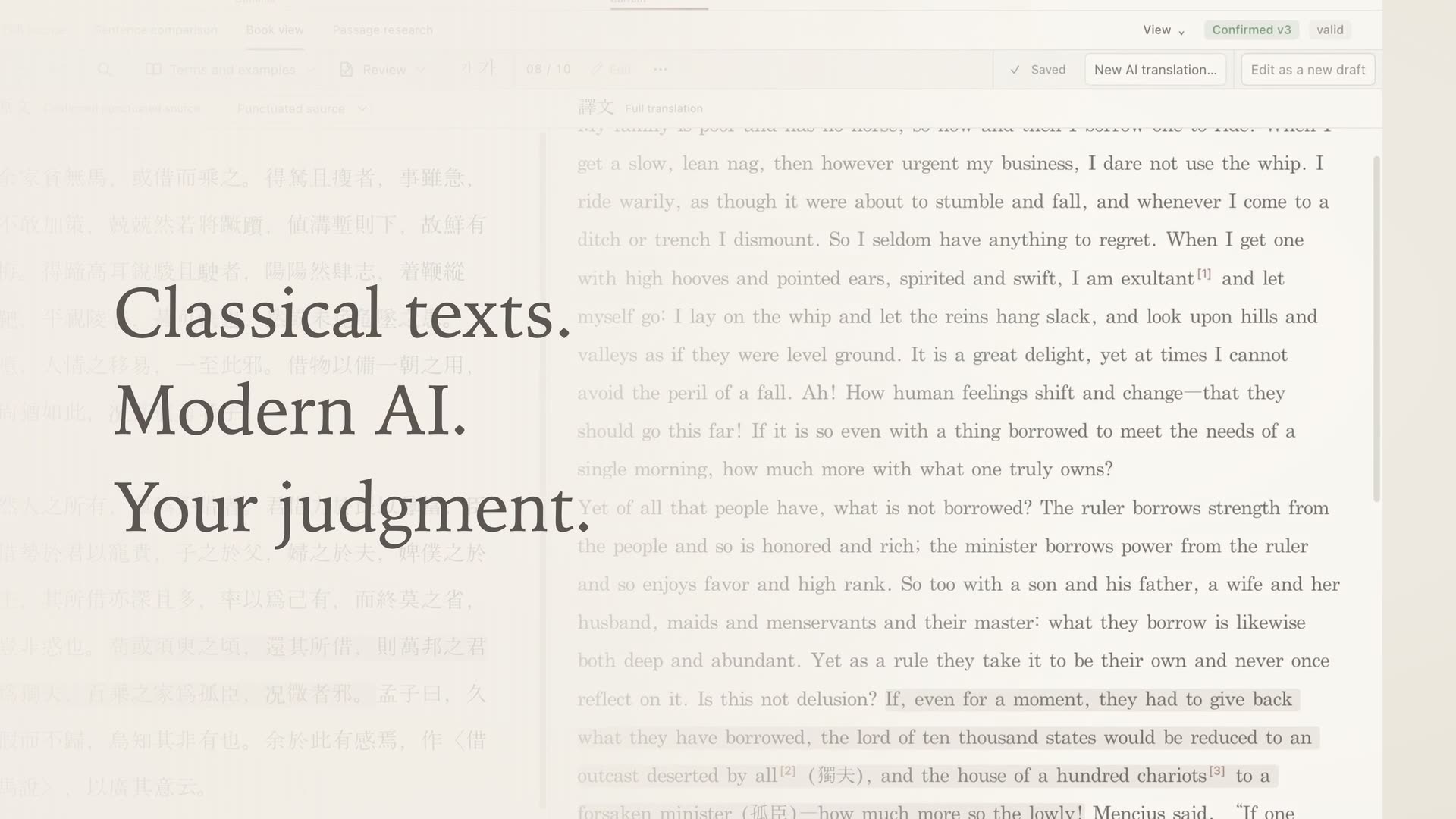
The review interface keeps the original text close to the draft. This helps the translator inspect wording and revise a passage without losing the source context.
AI assistance integrates with the user’s Claude, Codex, or Antigravity CLI. The application provides the translation workflow around those tools.
Munhae Studio is a beta product. Its earlier batch-translation tool shortened one translator’s first-draft work from weeks to hours; that experience motivated a fuller research and review workspace.
The design challenge is to make assistance useful while keeping the translator’s decisions visible and editable. I continue to develop the product around that balance.